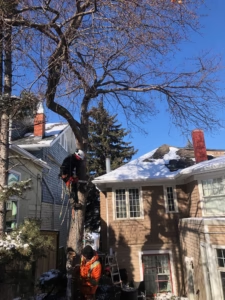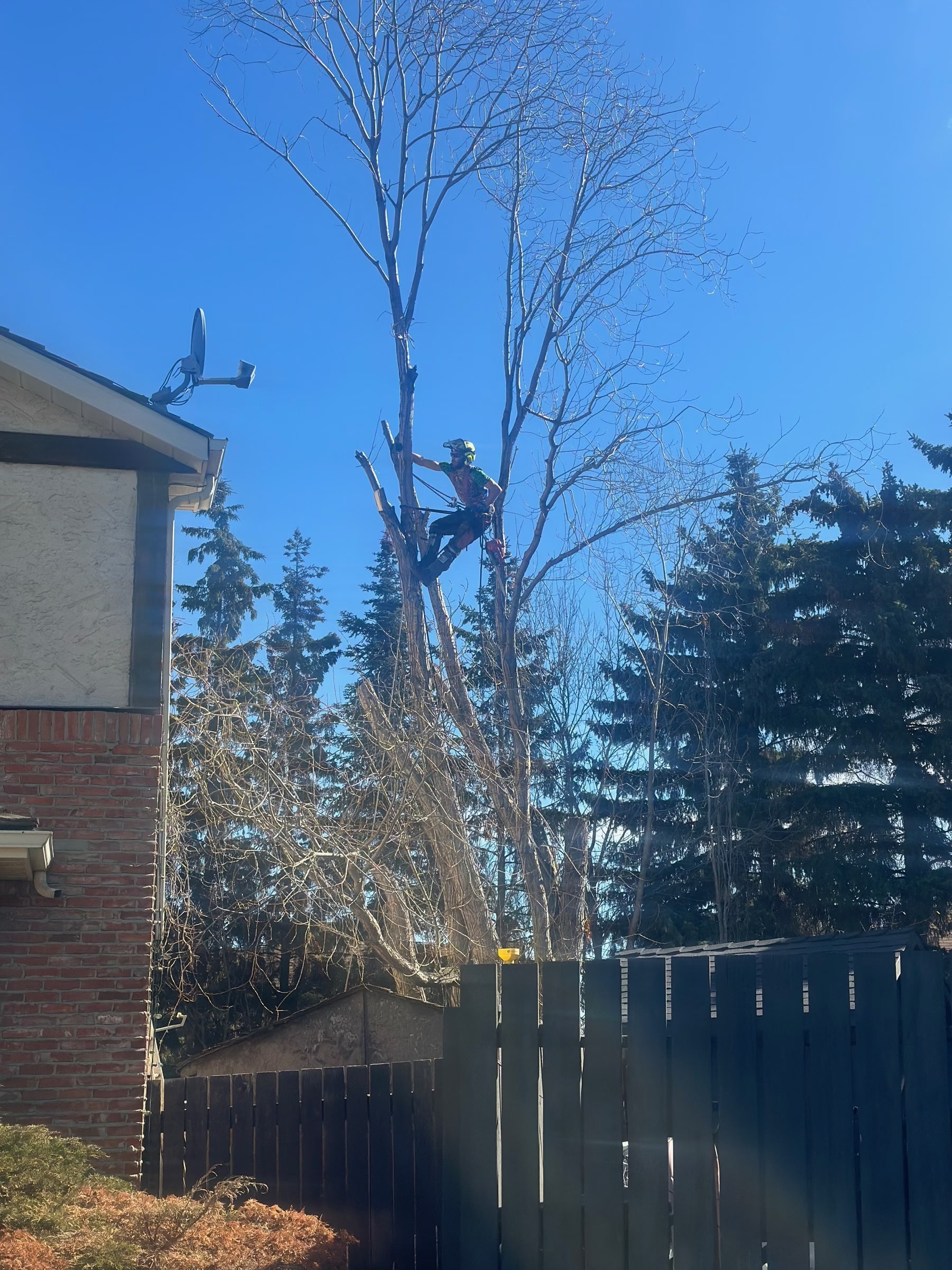
One of the most common questions we get: is this tree dead, or is it just having a bad year? Sometimes it’s obvious. A lot of the time it isn’t, especially in the fall and winter when every deciduous tree in Edmonton looks dead.
Here’s how to tell, what to look for on the trees we see the most, and when it’s time to take it down.
Quick Checks You Can Do Yourself
The scratch test. Use your thumbnail or a pocket knife to scratch a little bark off a small branch. Green and moist underneath means that branch is alive. Brown and dry means it’s dead. Try a few branches in different spots, because a tree can be dead on one side and alive on the other.
The snap test. Bend a thin twig. A live one bends. A dead one snaps clean and is dry inside.
Check the buds. Even in winter, a live tree has buds set for next spring. If they’re shrivelled and dry, or there just aren’t any, that’s a bad sign.
Wait for spring. If it’s a leafy tree and you’re not sure, the real test is May and June. A tree that leafs out on only half its branches, or not at all, is telling you something.
Signs A Tree Is Dead Or Dying
- Bark falling off in sheets, especially with bare wood showing underneath
- Mushrooms or shelf-like fungus growing on the trunk or at the base
- Deep cracks or splits in the trunk, or a big limb hanging by a strip
- A lot of dead branches in the top of the tree (we call it dieback)
- A tree that’s started leaning when it used to stand straight, especially if the soil on one side is lifting
- Woodpeckers working it over all the time, which usually means bugs in dead wood
One of these on its own doesn’t always mean the tree is done. Three or four together usually does.
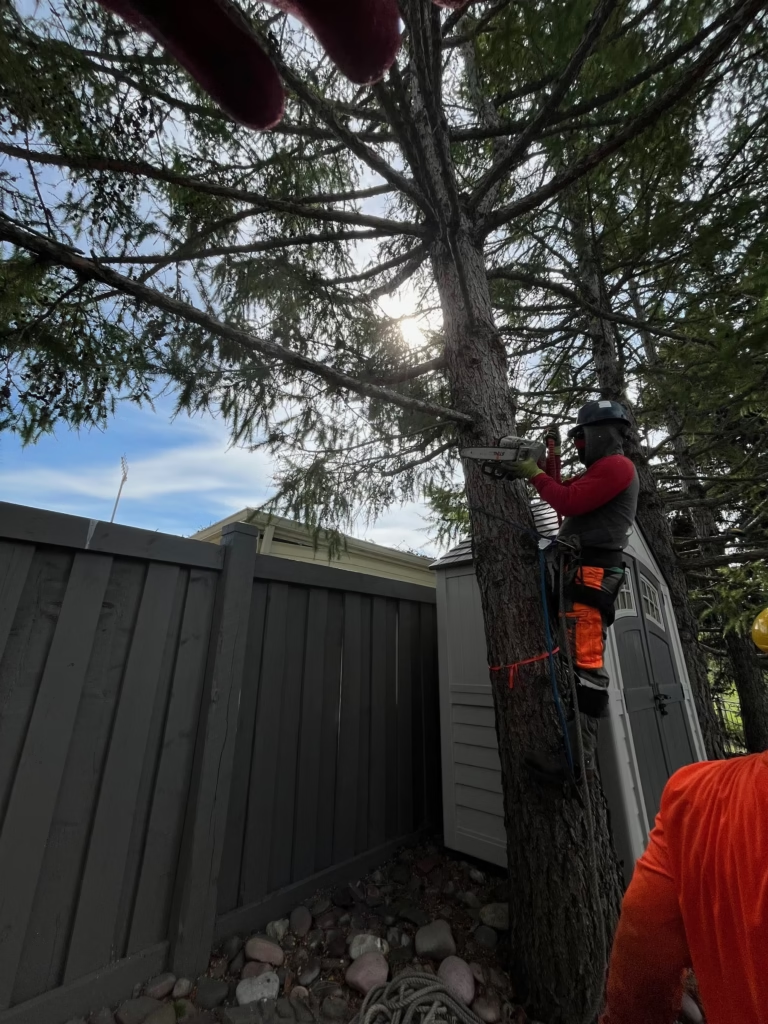
The Trees We See Die The Most In Edmonton
Swedish columnar aspens. These were planted everywhere for privacy, and they don’t live long. A lot of the ones planted in the 80s and 90s are at the end of their life now, and bronze leaf disease is killing more of them. If yours has brown, bronze leaves in late summer and dead tops, it’s probably on its way out. We wrote about what to plant instead of Swedish aspens.
Spruce. A spruce that’s gone brown all over isn’t coming back. Spruce don’t grow new needles on branches that have died, so a bare spruce stays bare. A few dead lower branches on an old spruce is normal. Brown from top to bottom is not.
Elm. If an elm’s leaves wilt and turn yellow or brown in the middle of summer, that’s a warning sign for Dutch Elm Disease, which is in Edmonton now. Elms have their own rules, so read our post on elm pruning season before anyone touches it.
Dead Trees Don’t Get Safer
A dead tree dries out and gets brittle. Branches start dropping, usually in the first big wind or the first heavy snow. The longer it stands, the more likely it lets go on its own, and the harder it is for a climber to work in safely.
If it’s over the house, the garage, the fence or a neighbour’s yard, don’t wait on it. If it’s already come down, we do emergency tree removal too.
Partly Dead? It Might Just Need A Prune
Not every tree with dead branches has to go. If most of the tree is healthy, cutting out the deadwood can buy it years. That’s a tree trimming job, not a removal. When we’re not sure, we’ll tell you which one makes sense.
What It Costs To Take Down A Dead Tree
A dead columnar aspen usually runs $600 to $1,000, and a small dead tree in the front yard is often around $400 to $600. Big trees over the house cost more. Prices are before GST and seniors get 10% off. The full breakdown is on our tree removal cost page.
Not Sure? Send Us A Photo
Take a picture of the whole tree and a close-up of anything that looks off, and send it over. We’ll tell you if it’s dead and get you a price, usually the same day. Use the quote form or text (780) 266-1919. More on how we do it on our tree removal in Edmonton page.